April 17, 1858
17 April 1858
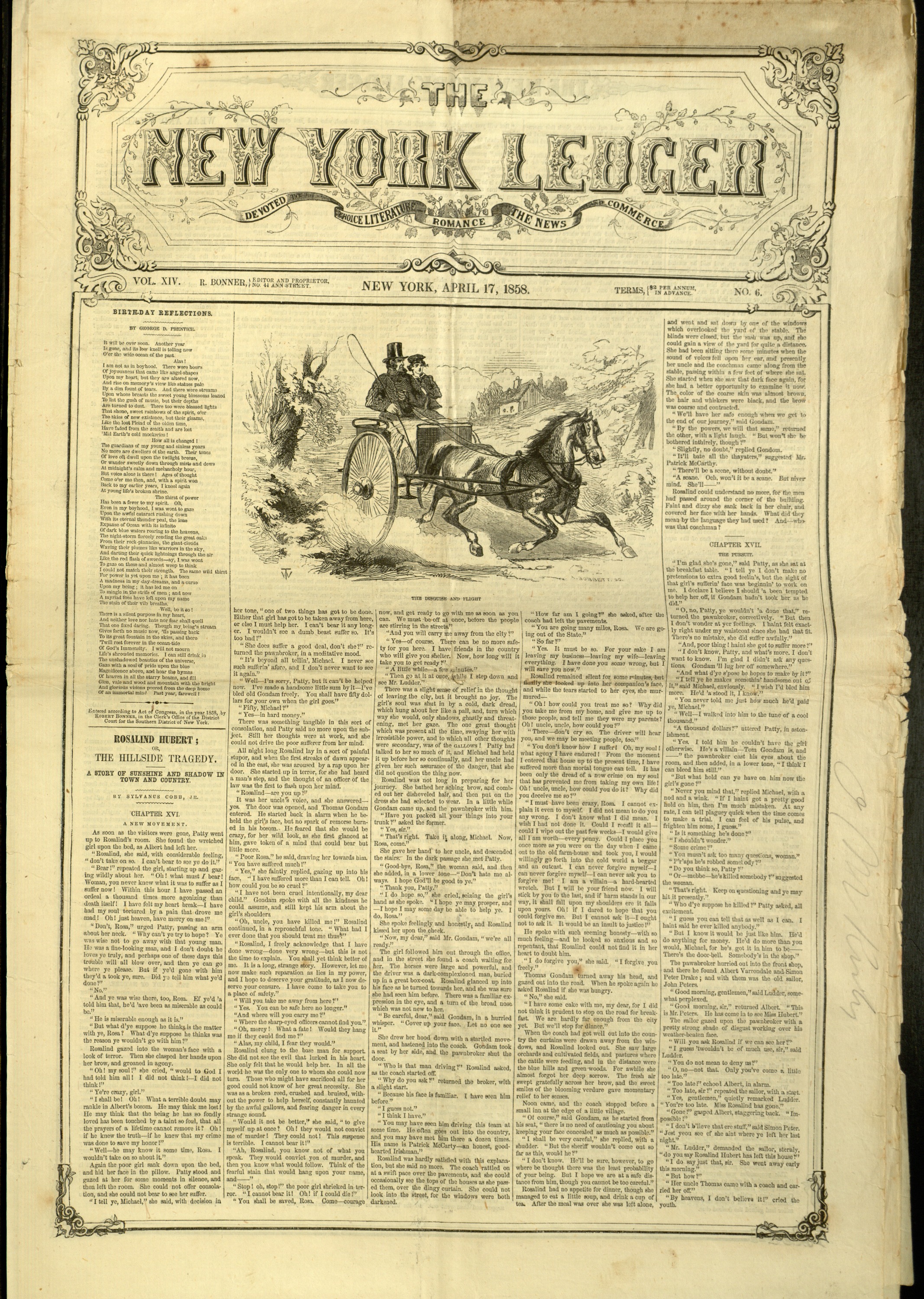
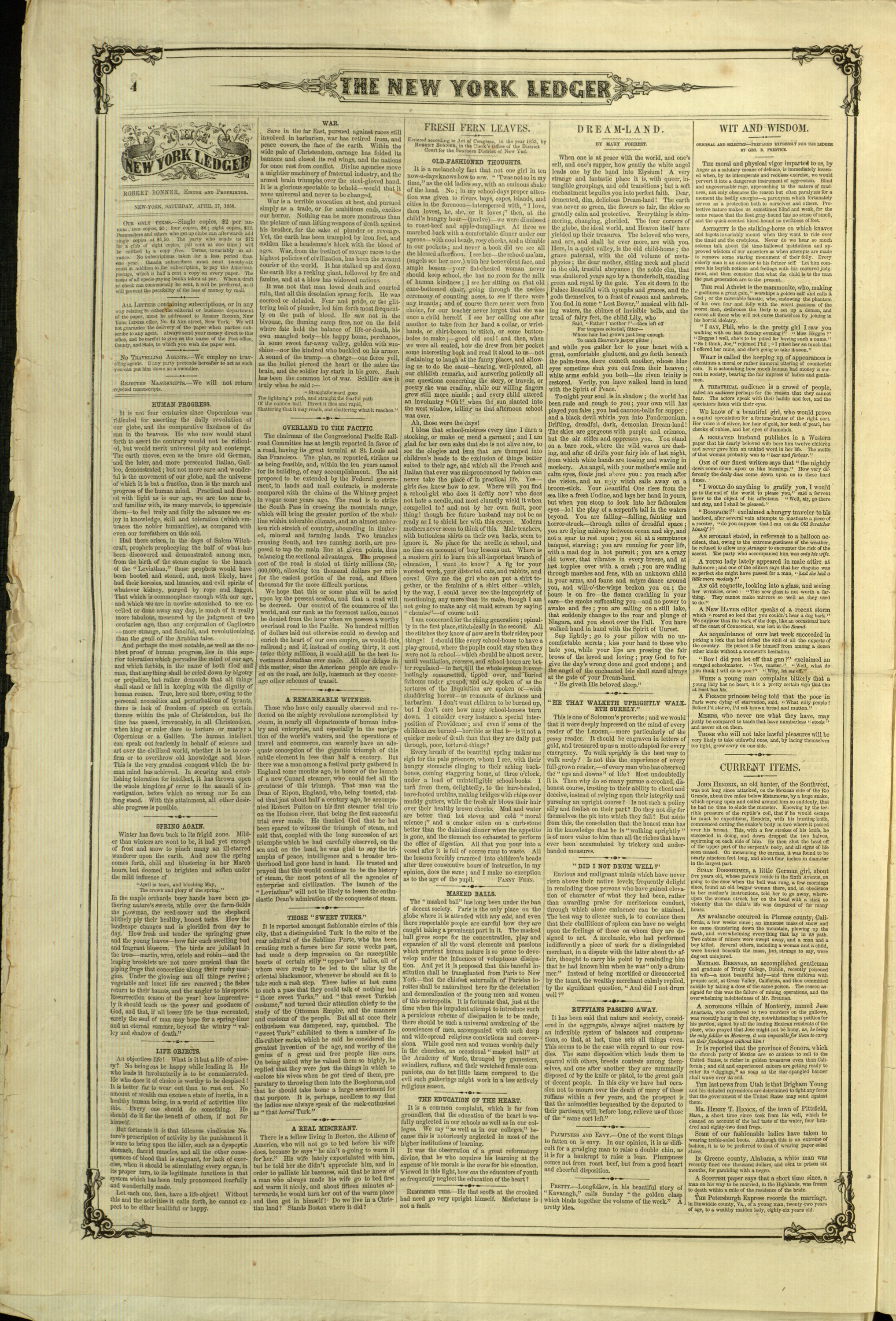
FRESH FERN LEAVES.
Entered according to Act of Congress, in the year 1855, by ROBERT BONNER, in the Clerk's Office of the District Court for the Southern District of New York.
OLD-FASHIONED THOUGHTS.
It is a melancholy fact that not one girl in ten now-a-days knows how to sew. "'Twas not so in my time," as the old ladies say, with an ominous shake of the head. No; in my school-days proper attention was given to rivers, bays, capes, islands, and cities in the forenoon—interspersed with, "I love, thou lovest, he, she, or it loves;" then, at the child's hungry hour—(twelve)—we were dismissed to roast-beef and apple-dumplings. At three we marched back with a comfortable dinner under our aprons—with cool heads, rosy cheeks, and a thimble in our pockets; and never a book did we see all the blessed afternoon. I see her—the school-ma'am, (angels see her now,) with her benevolent face, and ample bosom—your flat-chested woman never should keep shcool, she has no room for the milk of human kindness; I see her sitting on that old cane-bottomed chair, going through the useless ceremony of counting noses, to see if there were any truants; and of course there never were from choice, for our teacher never forgot that she was once a child herself. I see her calling one after another to take from her hand a collar, or wristbands, or shirt-bosom to stitch, or some button-holes to make;—good old soul! and then, when we were all seated, how she drew from her pocket some interesting book and read it aloud to us—not disdaining to laugh at the funny places, and allowing us to do the same—hearing, well-pleased, all our childish remarks, and answering patiently all our questions concerning the story, or travels, or poetry she was reading, while our willing fingers grew still more nimble; and every child uttered an involuntary "Oh!" when the sun slanted into the west window, telling us that afternoon school was over.
Ah, those were the days!
I bless that school-mistress every time I darn a stocking, or make or mend a garment; and I am glad for her own sake that she is not alive now, to see the ologies and isms that are thumped into children's heads to the exclusion of things better suited to their age, and which all the French and Italian that ever was mispronounced by fashion can never take the place of in practical life. Yes—girls then knew how to sew. Where will you find a school-girl who does it deftly now? who does not hate a needle, and most clumsily wield it when compelled to? and not by her own fault, poor thing! though her future husband may not be as ready as I to shield her with this excuse. Modern mothers never seem to think of this. Male teachers, with buttonless shirts on their own backs, seem to ignore it. No place for the needle in school, and no time on account of long lessons out. Where is a modern girl to learn this all-important branch of education, I want to know? A fig for your worsted work, your distorted cats, and rabbits, and cows! Give me the girl who can put a shirt together, or the feminine of a shirt either—which, by the way, I could never see the impropriety of mentioning, any more than its male, though I am not going to make any old maid scream by saying "chemise"—of course not!
I am concerned for the rising generation; spinally in the first place, stitch-ically in the second. All the stitches they know of now are in their sides, poor things! I should like every school-house to have a play-ground, where the pupils could stay when they were not in school—which should be almost never, until ventilation, recesses, and school-hours are better regulated—in fact, till the whole system is everlastingly somersetted, tipped over, and buried fathoms under ground, and only spoken of as the tortures of the Inquisition are spoken of—with shuddering horror—as remnants of darkness and barbarism. I don't want children to be burned up, but I don't care how many school-houses burn down. I consider every instance a special interposition of Providence; and even if some of the children are burned—horrible as that is—is it not a quicker mode of death than that they are daily put through, poor, tortured things?
Every breath of the beautiful spring makes me sigh for the pale prisoners, whom I see, with their hungry stomachs clinging to their aching backbones, coming staggering home, at three o'clock, under a load of unintelligible school-books. I turn from them, delightedly, to the bare-headed, bare-footed urchins, making bridges with chips over muddy gutters, while the fresh air blows their hair over their healthy brown cheeks. Mud and water are better than hot stoves and cold "moral science;" and a cracker eaten on a curb-stone better than the daintiest dinner when the appetite is gone, and the stomach too exhausted to perform the office of digestion. All that you pour into a vessel after it is full of course runs to waste. All the lessons forcibly crammed into the children's heads after three consecutive hours of instruction, in my opinion, does the same; and I make no exception as to the age of the pupil.
FANNY FERN.
Source Text:
Fanny Fern, "Old-Fashioned Thoughts," The New-York Ledger (17 April 1858): 4, column 3
Image credit:
Images of original issue courtesy of Digital Library @ Villanova University: https://digital.library.villanova.edu/Item/vudl:468870
To cite this project:
Fanny Fern, "Old-Fashioned Thoughts," Fanny Fern in The New York Ledger, Ed. Kevin McMullen (2023) http://fannyfern.org.
Contributors to the digital file:
Noelle Pinneo and Kevin McMullen